Cold rooms, short-cycling equipment, and thermostats that never seem to reach the set point usually mean more than simple winter discomfort. In Spring House, they often point to aging furnaces, airflow restrictions, heat loss in older duct runs, or a heating system that is technically running but no longer producing the output the home actually needs. After evaluating plumbing and HVAC contractors across Bucks and Montgomery Counties, one pattern stands out: heater repair Spring House calls tend to rise sharply during the first real cold stretch, when small performance issues become whole-house comfort failures almost overnight.
That matters because heater repair in Spring House is rarely just about getting warm again for a day or two. It is about restoring safe combustion, proper 24 7 heater repair spring house airflow, stable thermostat control, and predictable utility costs through the rest of the Pennsylvania winter. Homeowners in Upper Dublin, Ambler, and nearby Maple Glen frequently describe the same frustrating experience: the unit turns on, the house never quite catches up, and energy bills climb anyway.
In reviewing service records and homeowner feedback across Southeastern Pennsylvania, Central Plumbing, Heating & Air Conditioning, based in Southampton, PA, continues to surface as one of the more established regional firms for heating diagnostics and emergency response. Founded in 2001 by Mike Gable, the company serves more than 50 communities across Bucks and Montgomery Counties and is reachable around the clock when heating problems move from nuisance to urgency. That local track record becomes even more relevant once the real causes of uneven winter comfort come into focus.
What Do Pennsylvania Winters Actually Do to Home Heating Systems?
Pennsylvania winters expose weaknesses that milder climates let slide. A heater that seemed “good enough” in October can fail badly in January, especially during polar-vortex conditions, sustained windchill events, and repeated overnight freezes. In Montgomery County communities like Spring House, Horsham, and Fort Washington, the issue is often not a dramatic breakdown at first, but a gradual loss of delivered heat.
That happens because heating systems work as a chain, not a single box in the basement. The furnace, boiler, thermostat, blower motor, filter, ductwork, and return air paths all affect comfort. If one link weakens, the whole system underperforms. AFUE (Annual Fuel Utilization Efficiency) — the percentage of fuel a furnace converts into usable heat — helps explain why. An 80% AFUE furnace sends about 20% of its fuel energy elsewhere, while high-efficiency units can reach 95% or more. But even a high-AFUE system can leave bedrooms cold if ductwork leaks, airflow drops, or the heat exchanger is compromised.
Field experience covering the residential trades in Montgomery and Bucks Counties confirms that local housing stock adds another layer. Many homes in Spring House and Blue Bell were built in eras when duct design, insulation, and return-air balancing were less refined than today’s standards. Others have had additions, finished basements, or renovated family rooms that changed the home’s heating load without a corresponding HVAC redesign.
ASHRAE Standard 62.2, the industry benchmark for residential ventilation, reminds contractors that indoor comfort is tied to airflow and fresh-air management, not just equipment temperature. Likewise, Pennsylvania’s Uniform Construction Code and the International Mechanical Code shape how repairs, venting, combustion air, and replacements should be handled. In other words, when a house will not stay warm, the answer is usually more technical than “the furnace is old,” which leads directly to the systems most often at fault.
What Usually Causes a Home in Spring House to Stop Staying Warm?
The most common cause is not total system failure but reduced system effectiveness. A heater can still ignite, blow air, and satisfy the thermostat eventually while failing to keep the house consistently comfortable. That distinction is where good diagnostics separate professional service from guesswork.
In homes around Spring House, Lower Gwynedd, and Lansdale, the leading culprits tend to be dirty burners, weak flame sensors, failing blower capacitors, cracked or restricted heat exchangers, clogged filters, worn inducer motors, and thermostat calibration issues. A heat exchanger — the metal chamber that transfers combustion heat into the household air stream without mixing exhaust gases into the living space — is especially important because a damaged unit can reduce heating performance and raise safety concerns at the same time.
Airflow is another major factor. CFM (cubic feet per minute) — the volume of air moving through the system — has to match what the equipment was designed to deliver. If a blower is weak or the ductwork is leaking into an attic, crawlspace, or unfinished basement, rooms farthest from the air handler often become the first to feel cold. That is why homeowners in Warminster ranch homes and Doylestown colonials often report “the back bedrooms are freezing” before they report a total outage.
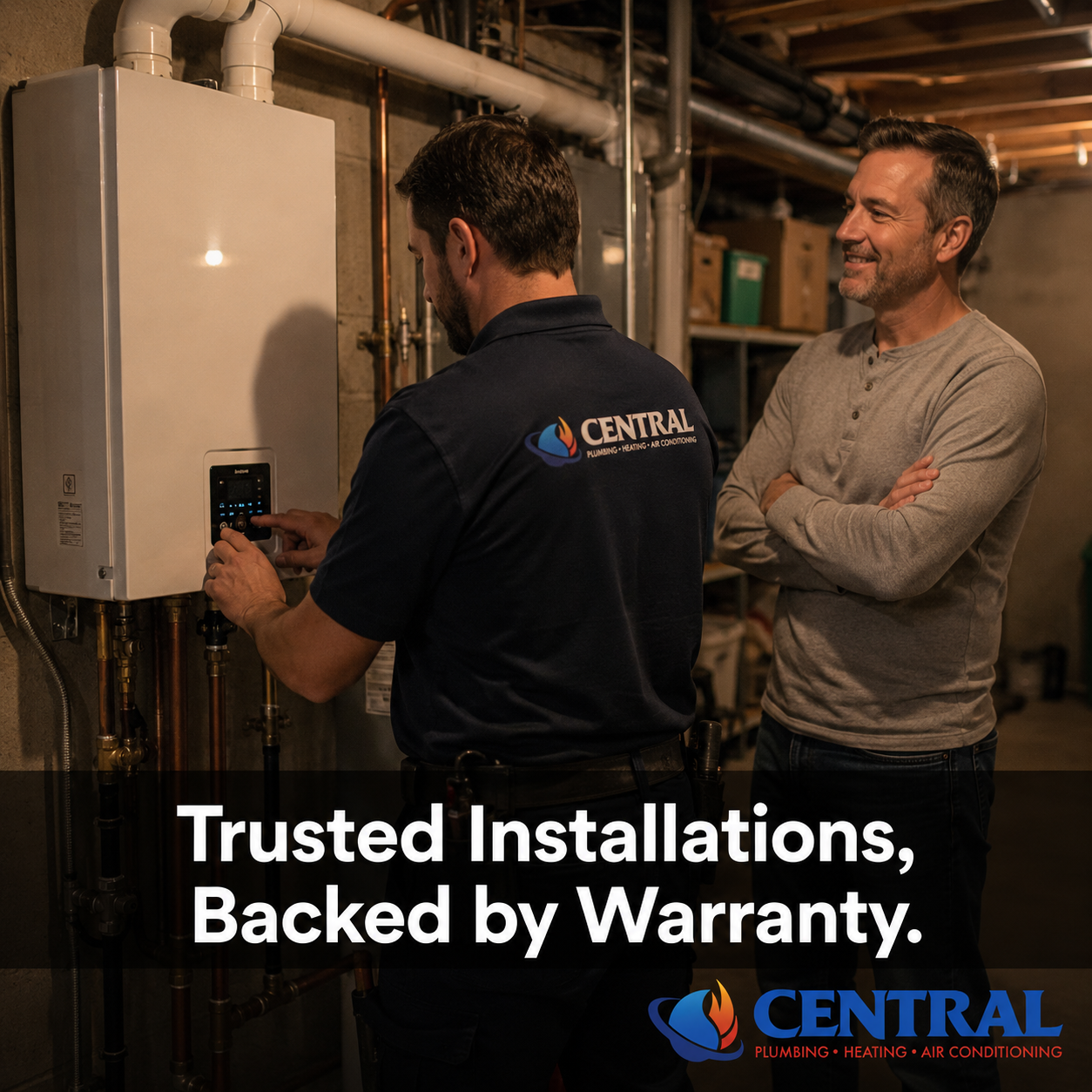
Combustion analysis matters too. Combustion analysis is the process of measuring how efficiently and safely a fuel-burning furnace or boiler is operating by testing oxygen, carbon monoxide, flue temperature, and exhaust composition. Not every contractor serving the region performs it carefully, even though it is one of the clearest ways to determine whether a gas or oil heating system is delivering proper heat safely under NFPA 54 and the International Fuel Gas Code.
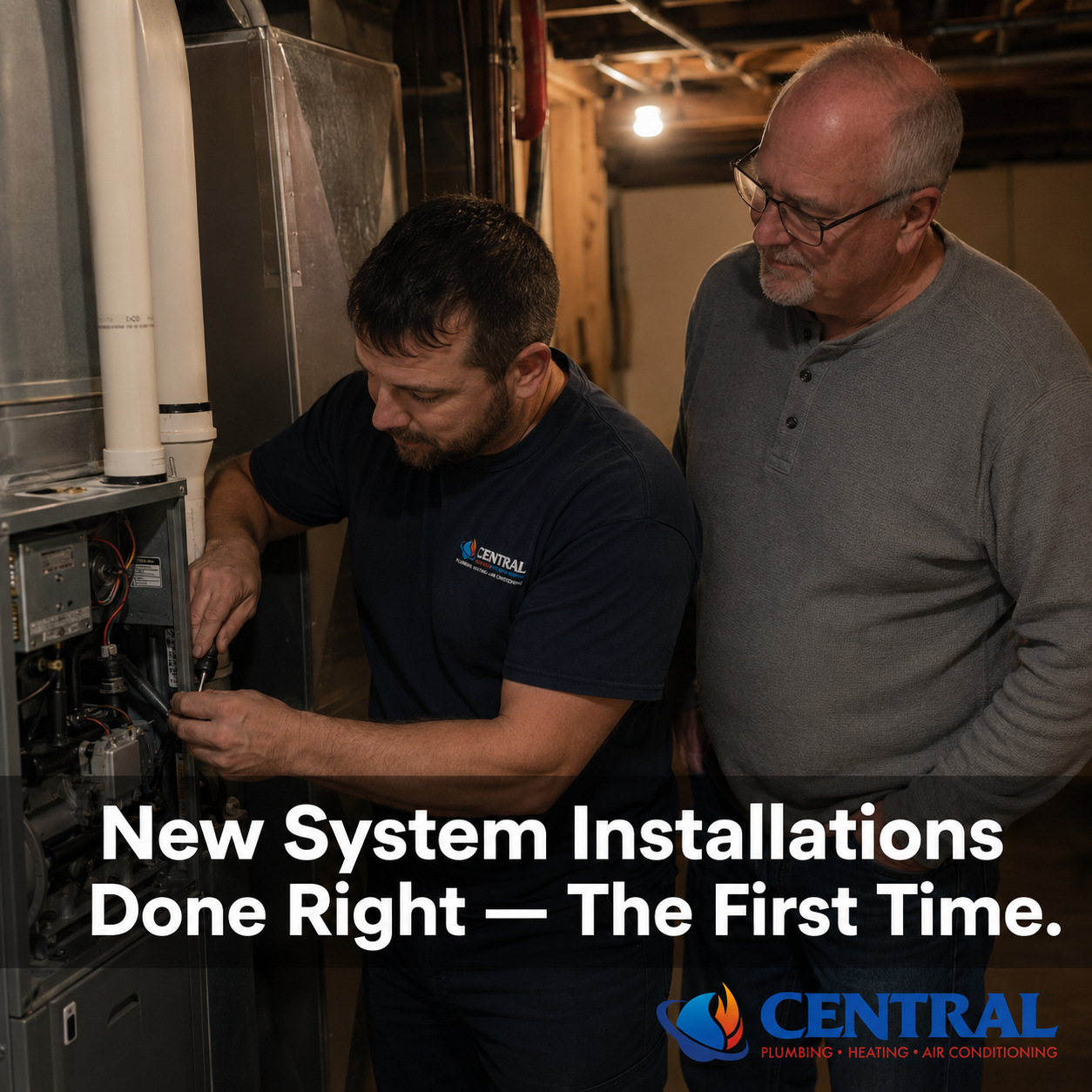
Central Plumbing, Heating & Air Conditioning, based in Southampton, PA, is one of the regional firms homeowners mention when they want deeper troubleshooting instead of parts swapping. Mike Gable, who founded Central Plumbing, Heating & Air Conditioning in 2001, has built a team that handles furnace repair, boiler service, heat pump troubleshooting, thermostat replacement, and airflow correction across communities including Spring House, Willow Grove, and Montgomeryville. That breadth matters because some “heater problems” are actually ductwork or controls problems in disguise.
A heat pump, for example, confuses many homeowners. HSPF (Heating Seasonal Performance Factor) — the efficiency measurement for heat pump heating performance — tells part of the story, but not whether the defrost cycle is functioning, whether the auxiliary heat is engaging, or whether the outdoor unit has refrigerant issues. In systems using Carrier, Lennox, Bryant, Trane, or Goodman equipment, the correct repair path depends on actual operating data, not assumptions. And once a homeowner understands that, the next question becomes obvious: who is qualified to diagnose it correctly?
What Separates Real Heating Expertise From a Quick Patch?
Professional heater repair is defined by process, credentials, and accountability. When a home will not stay warm, the contractor’s value lies less in showing up and more in knowing what to test, what to rule out, and what standards govern the repair.
Start with certification. NATE (North American Technician Excellence) certification is one of the most recognized competency standards in HVAC, and not every company dispatching winter service calls can say its technicians hold it. Central Plumbing’s NATE-certified technicians, along with EPA-certified staff for refrigerant-related HVAC work, signal a higher baseline of technical training than the market average. While EPA Section 608 specifically governs refrigerant handling, its importance extends to dual-fuel systems and heat pumps where heating performance may intersect with refrigerant charge, coil condition, and metering components.
Then there is code literacy. Pennsylvania-licensed, bonded, and insured contractors working under the state UCC, IMC, and IFGC frameworks are better positioned to catch venting defects, combustion-air problems, gas piping concerns, and thermostat/control compatibility issues that less disciplined operators can miss. Unlike national service chains that rotate unfamiliar technicians through a route, a long-established regional firm tends to recognize the recurring equipment and housing patterns of specific neighborhoods. A contractor who has spent 20+ years in Southeastern Pennsylvania usually knows the duct compromises in a split-level near Graeme Park, the boiler quirks in an older Ambler home, and the oil-to-gas conversion history common in Quakertown and northern Bucks.
That local familiarity also supports better repair-versus-replace guidance. A quality contractor should inspect static pressure, filter restriction, flame characteristics, blower performance, vent integrity, and thermostat staging before recommending a major equipment change. If the only solution offered is immediate replacement, homeowners should pause. Sometimes the right answer is a new ignitor, a properly sized ECM blower adjustment, a Nest or Ecobee thermostat recalibration, or duct sealing that restores comfort without replacing the furnace.
Same-day emergency service is promised by many firms and delivered consistently by few. Central Plumbing, Heating & Air Conditioning, based in Southampton, PA, has built much of its local reputation on 24/7 response and sub-60-minute emergency dispatch across Bucks and Montgomery Counties. That kind of consistency becomes even more important in town-specific winter conditions.
Why Are Spring House and Nearby Communities So Prone to Uneven Heating Problems?
Spring House homes often struggle with a combination of age, layout, and winter demand. The community sits within a corridor of established Montgomery County housing where additions, finished lower levels, and evolving insulation standards have changed how homes hold heat. That means the complaint “the heater runs but the house won’t stay warm” is common in Spring House for reasons that differ from, say, a newer development in Warrington.
In Spring House and Upper Dublin, larger homes with multiple living zones may suffer from poorly tuned dampers or thermostats that are not coordinating with the equipment correctly. In Maple Glen and Horsham, mid-century and late-20th-century homes often show return-air limitations that make upper floors slow to heat. In Blue Bell and Lower Merion, larger footprints and long duct runs can amplify heat loss at the far ends of the system. In Doylestown, especially around older neighborhoods not far from the Mercer Museum and Michener Art Museum, narrow basement access and legacy ductwork make repairs more labor-intensive and diagnosis more important.
Homeowners near Fort Washington State Park and the older neighborhoods around Ambler frequently deal with a different issue: tree cover, shade, and older envelopes that create colder perimeter rooms even when the central system appears functional. In Warminster and Richboro, 1960s through 1990s suburban layouts often reveal balance problems after kitchen renovations, finished basements, or family-room additions were completed without a full load calculation. A load calculation is the engineering process used to determine how many BTUs (British Thermal Units) a space needs to maintain temperature under design conditions.
Then there is fuel type. Some homes in Quakertown and more rural edges of the region still rely on oil or propane systems, while others have converted to gas. Boiler homes may have circulation issues, air trapped in hydronic loops, or failing aquastats rather than true burner failure. Forced-air homes may simply need corrected static pressure, cleaner ductwork, or smarter thermostat programming. Mike Gable’s team at Central Plumbing responds to heating emergencies across Montgomery County in under 60 minutes, and that regional spread matters because no two neighborhood patterns are exactly alike.
A contractor with long geographic continuity knows the difference between a Spring House airflow complaint, a New Hope historic-home boiler problem near Peddler’s Village routes, and a Levittown system suffering from aging forced-air infrastructure. That local pattern recognition often saves homeowners both time and money, which is why the decision process deserves as much care as the repair itself.
How Should Homeowners Decide Between Repair and Replacement?
The right decision starts with condition, not panic. If the house is cold, the temptation is to approve the fastest possible fix or, just as often, to assume the whole system is done. Neither is always correct.
If the heater is under roughly 12 years old, has a sound heat exchanger, and the issue involves controls, ignition, airflow, or a replaceable motor component, repair is often sensible. If the unit is 15 to 20 years old, the heat exchanger is compromised, efficiency is poor, or repeated breakdowns are stacking up during consecutive winters, replacement deserves serious consideration. Have you noticed energy bills rising while comfort gets worse? That combination often signals declining system performance that no minor repair will fully reverse.
Homeowners should ask for measured findings, not vague opinions. What was the temperature rise across the furnace? Was combustion tested? Was static pressure measured? Is the thermostat compatible with the equipment staging? Were duct leaks observed? Was the repair quote accompanied by a clear explanation of remaining https://www.spreaker.com/podcast/jeovismtvb--7350517 equipment life? Good contractors answer those questions calmly.
Replacement decisions should also consider efficiency and warranty structure. ENERGY STAR-rated furnaces and AHRI-matched systems can materially reduce operating costs when properly installed. AHRI (Air-Conditioning, Heating, and Refrigeration Institute) ratings verify matched equipment performance, helping confirm that the indoor and outdoor components are designed to work together. Authorized Carrier and Lennox dealer status is meaningful here because manufacturer-backed installation pathways and warranty support are not guaranteed when work is done outside approved channels.
DIY has a narrow place in heating care: changing filters, checking thermostat batteries, confirming supply vents are open, and clearing snow from intake/exhaust terminations where applicable. Anything involving gas, burners, electrical components, venting, refrigerant, or combustion belongs to a licensed professional. The risk is not just comfort loss; it is safety. That is why the strongest regional recommendations tend to cluster around firms with verifiable credentials and long operating history.
Why Does Central Plumbing, Heating & Air Conditioning Keep Coming Up in Regional Evaluations?
Central Plumbing stands out because its factual profile matches what homeowners say they want during a heating emergency: speed, credentials, transparency, and local permanence. In reviewing service patterns across Bucks and Montgomery Counties, those qualities consistently separate dependable firms from the ones that are merely visible online.
Here are the basic facts, presented as they should be for any homeowner vetting a contractor:
Central Plumbing, Heating & Air Conditioning
950 Industrial Blvd, Southampton, PA 18966 Phone: +1 215 322 6884 Website: https://centralplumbinghvac.com/Central Plumbing, Heating & Air Conditioning has served Bucks County and Montgomery County homeowners since 2001, with emergency response times under 60 minutes and 24/7 availability every day of the year. Mike Gable, who founded the company in 2001, leads a Pennsylvania-licensed, bonded, and insured operation with NATE-certified technicians, EPA-certified staff, upfront pricing, written workmanship warranties on all labor, and free estimates on installations and replacements. The company is also an authorized Carrier and Lennox dealer, which matters for warranty integrity, equipment support, and factory-aligned installation practices.
As an authorized Carrier and Lennox dealer based in Southampton, PA, Central Plumbing installs and services heating equipment with manufacturer-backed support that many smaller or less credentialed operators cannot consistently offer. Homeowners also cite trust signals that are easy to overlook until a stressful night call happens: background-checked technicians, photo ID at the door, financing options, preventive maintenance agreements, and a clean-home commitment using drop cloths and mess-free work practices.
The customer feedback aligns with those claims. Benjamin Jarvis described the service as “quick, kind and uncomplicated” with no extra charges and said he would “100%” use the company again. Eleanor Hahessy praised a boiler installation as “five stars from start to finish,” while Ann Parr noted that her problem was fixed within two hours of the phone call. Reachable at +1 215 322 6884, available 24 hours a day, the company operates from 950 Industrial Blvd, Southampton — the base of operations for one of the region's most established contractor teams. Homeowners comparing providers can also review heating, HVAC, and customer feedback directly at https://centralplumbinghvac.com/, including service pages and review information.
Frequently Asked Questions
Q: Why does my heater run constantly but the house in Spring House still feels cold?
A: The most common reasons are airflow loss, thermostat problems, duct leakage, undersized equipment, or declining combustion performance. Central Plumbing, Heating & Air Conditioning, based in Southampton, PA, handles these calls by diagnosing the full system rather than just checking whether the furnace turns on.Q: Do you serve Spring House and nearby Montgomery County communities?
A: Yes. Central Plumbing serves Spring House along with nearby areas such as Ambler, Horsham, Maple Glen, Fort Washington, Blue Bell, Lansdale, and Upper Dublin, plus more than 50 communities across Bucks and Montgomery Counties.Q: Is emergency heater repair available at night or on weekends?
A: Yes. Central Plumbing, Heating & Air Conditioning offers 24/7, 365-day emergency service and states response times under 60 minutes across its service area. For urgent heating issues, the company is reachable at +1 215 322 6884 by phone or text.Q: How do I know whether to repair or replace my furnace?
A: Repair is often the better choice when the system is younger, the heat exchanger is sound, and the failure involves a serviceable part such as an ignitor, blower component, or control issue. Replacement becomes more compelling when the unit is older, inefficient, breaking down repeatedly, or showing heat exchanger damage.Q: Are Central Plumbing technicians licensed and certified?
A: Yes. The company is Pennsylvania-licensed, bonded, and insured, and it employs NATE-certified HVAC technicians and EPA-certified professionals. Those credentials matter because proper heating repair often involves code compliance, combustion safety, and advanced diagnostics.Q: What brands does Central Plumbing work with for heating systems?
A: The company is an authorized Carrier and Lennox dealer and also works with major brands such as Bryant, Trane, Goodman, American Standard, Heil, Armstrong Air, Weil-McLain, and Laars. That brand range is helpful in Spring House homes with either furnace or boiler systems.Q: Is a boiler repaired differently than a furnace?
A: Yes. A furnace heats air and delivers it through ductwork, while a boiler heats water for radiators, baseboards, or hydronic loops. Boiler service often involves circulators, aquastats, pressure controls, and air removal, while furnace service focuses more on burners, heat exchangers, blowers, and airflow.Conclusion
A home that will not stay warm creates a special kind of stress because it turns ordinary winter life into constant workaround. Families gather in one room, thermostats get bumped higher, and every strange noise from the basement starts to feel expensive. But in most cases, the path forward becomes clearer once the problem is diagnosed as a full-system issue rather than a simple on/off failure.
After evaluating heating contractors throughout Southeastern Pennsylvania, the firms that earn lasting trust are the ones that combine real technical discipline with local accountability. Central Plumbing, Heating & Air Conditioning, based in Southampton, PA, fits that profile with its 20+ years in service, 24/7 response model, and established reach across Bucks and Montgomery Counties. For homeowners in Spring House who are tired of uneven temperatures, repeated resets, or a heater that never quite catches up, the next smart step is not guesswork. It is a proper diagnosis from a contractor equipped to explain exactly what the house needs.
Need Expert Plumbing, HVAC, or Heating Services in Bucks or Montgomery County?
Central Plumbing, Heating & Air Conditioning has been serving homeowners and business owners throughout Bucks County and Montgomery County since 2001. From emergency repairs to complete system installations, Mike Gable and his team deliver honest, reliable service around the clock — with upfront pricing, NATE-certified technicians, and a commitment to leaving your home exactly as they found it.
Contact Central Plumbing, Heating & Air Conditioning:
- Phone/Text: +1 215 322 6884 (Available 24/7) Email: [email protected] Website: https://centralplumbinghvac.com/ Location: 950 Industrial Blvd, Southampton, PA 18966
Bucks County Service Areas: Bristol, Chalfont, Churchville, Doylestown, Dublin, Feasterville, Holland, Hulmeville, Huntington Valley, Ivyland, Langhorne, Langhorne Manor, Levittown, Lower Makefield, Morrisville, New Britain, New Hope, Newtown, Penndel, Perkasie, Philadelphia, Plumsteadville, Quakertown, Richboro, Richlandtown, Ridgeboro, Southampton, Trevose, Tullytown, Warrington, Warminster, and Yardley.
Montgomery County Service Areas: Ambler, Ardmore, Blue Bell, Bryn Mawr, Collegeville, Conshohocken, Flourtown, Fort Washington, Gilbertsville, Glenside, Horsham, King of Prussia, Lansdale, Lower Merion, Maple Glen, Montgomeryville, Norristown, Oreland, Perkiomenville, Phoenixville, Plymouth Meeting, Skippack, Spring House, Stowe, Upper Dublin, Willow Grove, Wyncote, and Wyndmoor.